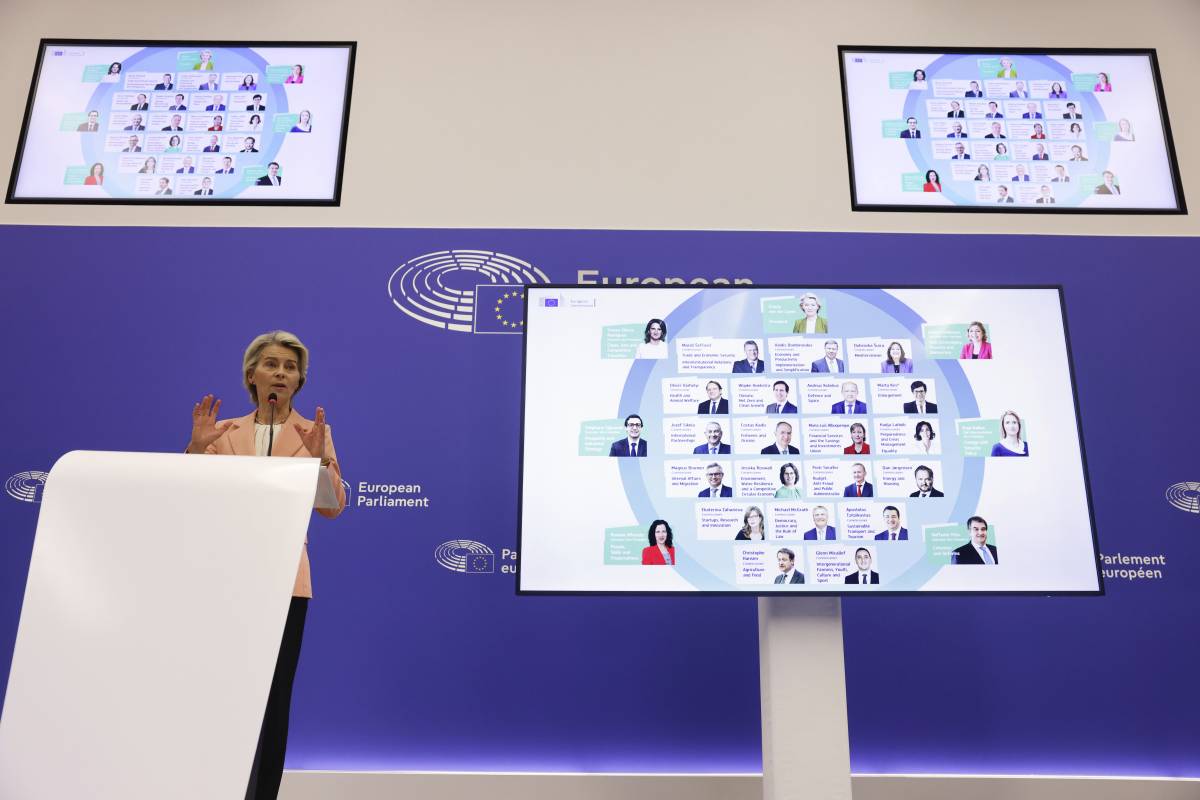
The Second von der Leyen Commission is the current European Commission, in office since 1 December 2024. It consists of one commissioner from each of the member states of the European Union – including Ursula von der Leyen, its president, who is from Germany.
The Commission was approved by the European Parliament on 27 November with 51% of the majority, the least supported European Commission by the Parliament since 1993, when it was given the right to vote on the college.
College of Commissioners
Structure of the College
The second Ursula von der Leyen commission will be organized on three levels:
- president;
- executive vice presidents;
- commissioners.
Regardless of the three-level structure of the commission, the president of the commission emphasized that all commissioners share collective responsibility for decisions made by the Commission.
Commissioner groups
According to portfolios the commissioner groups will be as following:
President
- Commissioner for Equality
- Commissioner for Implementation and Simplification
- Commissioner for Interinstitutional Relations and Foresight
- Commissioner for Budget, Anti-Fraud and Public Administration
Vice-President and High Representative for Foreign Affairs and Security Policy
- Commissioner for Enlargement
- Commissioner for Preparedness and Crisis Management
- Commissioner for the Mediterranean
- Commissioner for International Partnerships
Executive Vice-President for Tech Sovereignty, Security and Democracy (Commissioner for Digital and Frontier Technologies)
- Commissioner for Defence and Space
- Commissioner for Internal Affairs and Migration
- Commissioner for Democracy, Justice and the Rule of Law
- Commissioner for Startups, Research and Innovation
Executive Vice-President for Prosperity and Industrial Strategy (Commissioner for Industry, SMEs and the Single Market)
- Commissioner for Startups, Research and Innovation
- Commissioner for Trade and Economic Security
- Commissioner for Economy and Productivity
- Commissioner for Financial Services and the Savings and Investments Union
Executive Vice-President for Cohesion and Reforms (Commissioner for Cohesion Policy, Regional Development and Cities)
- Commissioner for Enlargement
- Commissioner for Fisheries and Oceans
- Commissioner for Sustainable Transport and Tourism
- Commissioner for Agriculture and Food
Executive Vice-President for People, Skills and Preparedness (Commissioner for Skills, Education and Culture, Quality Jobs and Social Rights)
- Commissioner for Mediterranean
- Commissioner for Preparedness and Crisis Management
- Commissioner for Intergenerational Fairness, Youth, Culture and Sport
- Commissioner for Health and Animal Welfare
Executive Vice-President for Clean, Just and Competitive Transition (Commissioner for Competition)
- Commissioner for Climate, Net Zero and Clean Growth
- Commissioner for Environment, Resilience and a Competitive Circular Economy
- Commissioner for Energy and Housing
- Commissioner for Health and Animal Welfare
Formation
Election of the President of the Commission
To be elected Commission President, a candidate must be proposed by the European Council with a reinforced qualified majority (at least 72% of the states representing at least 65% of the population) and receive a majority of the votes of the members of the European Parliament (at least 361 out of 720).
On 17 June, an "informal meeting" of the European Council was held, where the heads of state and government discussed the next institutional cycle and their candidate for the Commission presidency. On 25 June, negotiators from the EPP (Kyriakos Mitsotakis and Donald Tusk), PES (Pedro Sánchez and Olaf Scholz) and Renew Europe (Emmanuel Macron and Mark Rutte) reached a preliminary agreement on the nominations.
On 27 June, during the European Council meeting, national leaders proposed Ursula von der Leyen (EPP) as candidate for President of the European Commission, after being named the European People's Party nominee in March 2024. Hungary's Viktor Orban voted against von der Leyen and abstained on Kallas. Italy's Giorgia Meloni abstained from the vote on von der Leyen but voted against Costa and Kallas for their posts.
In the following weeks, von der Leyen had bilateral meetings with EPP, S&D, Renew, G/EFA and ECR groups to gather support for her re-election. On 18 July, she presented to the European Parliament her "Political Guidelines", followed by a debate with MEPs. Ursula von der Leyen was re-elected president of the European Commission in a secret ballot, with 401 votes in favour, 284 against, and 22 cast blank or invalid votes.
Selection of the Commissioners
The President-elect of the European Union invites the member states to nominate commissioners in accordance with the rules set out in the Treaty on the European Union and by the European Council. The President-elect decides on the organisation of their Commission, reviews the nominees, and presents a college of Commissioners, with each nominated Commissioner being responsible for a specific policy portfolio. The President-elect also appoints Vice Presidents among the Commissioners The President-elect's proposed College of Commissioners is reviewed by the European Parliament in committee hearings.
Commissioner candidates
On 25 July 2024, President-elect Ursula von der Leyen sent the letters to member states asking them to officially nominate candidates for the post of European Commissioner before 30 August 2024. As she did with her first commission, von der Leyen called for member states to each nominate two candidates for the European Commission, a woman and a man. However, Bulgaria is the only country to have followed Von der Leyen's request. All the other leaders of EU member states have each nominated only one candidate, and most of them are men. Romania originally put forward socialist MEP Victor Negrescu but later put forward MEP Roxana Mînzatu, switching a male nominee for a female nominee.
On 17 September 2024, Ursula von der Leyen announced in a press conference the college of commissioners and their portfolios. The share of women in the proposed commission is 40.7%, down from 44.4 percent in 2019. The average age of the new Commission nominees is 52, dropping from 56 in 2019. In terms of structure, there are six Executive Vice-Presidents, down from 7 (with 3 executive vice-presidents) in 2019. The proposed College includes five returning commissioners: three of them are for a second mandate (Šuica, Várhelyi, Hoekstra), while Dombrovskis would return for a third term, and Šefčovič for a fourth term. The portfolio repartition reflects the declared priorities, with a strong focus on competitiveness, industrial policy and defence.
On 19 September 2024, the Council of the European Union adopted, by common accord with the President-elect of the Commission, the list of persons whom it proposes for appointment as members of the Commission to the European Parliament.
Hearings
According to the Rule 129 of the Rules of Procedure of the European Parliament, the confirmation hearings are conducted by the appropriate committee or committees for each commissioner. According to the Annex VII of the Rules of Procedure of the European Parliament, the parliament has to evaluate Commissioners-designate based on their general competence, European commitment and personal independence. It has to assess knowledge of their prospective portfolio and their communication skills. Historically, the European Parliament has rejected at least one candidate during every mandate since 2004.
On 3 October 2024, the Conference of Presidents of the European Parliament agreed on the calendar for the hearings to be held from 4 to 12 November, and decided on the division of responsibilities among committees for the confirmation hearings.
Election of the Commission
The College of Commissioners are subjected to the confirmation by a majority of the votes cast by the European Parliament. On 27 November, the new Commission was approved by Parliament, with 370 MEPs voting in favour, 282 against, and 36 abstentions. This corresponds to a 51 % majority of all members, the least supported European Commission by the Parliament since 1993, when it was given the right to vote on the college., and fewer than the 401 MEPs who voted for the election of the Ursula Von der Leyen as Commission President.
After being approved by the Parliament, the Commission was formally appointed by the European Council, acting by a qualified majority, on 28 November. It subsequently assumed office on 1 December 2024.
Policy
European Green Deal
The European Green Deal, approved in 2020, is a set of policy initiatives by the Von der Leyen Commission with the overarching aim of making the European Union climate neutral in 2050. In November 2024, Vice-President for Clean, Just and Competitive Transition, Teresa Ribera, expressed support for the European Green Deal and the green transition. She said in an interview with El Pais: "Ursula Von der Leyen has given me a vice presidency: It's a signal that [the green agenda] remains a priority. Environmental transition is one of the great engines of the approaching economic and industrial transformation." In December 2024, Ribera warned that the Commission would not postpone the ban on the sale of combustion engine cars in the EU after 2035.
On 26 February 2025, the Commission announced a collection of measures backed by 100 billion euros ($104.94 billion) to support EU-made clean manufacturing, called the Clean Industrial Deal. Ribera said that "By 2030, the EU’s renewable targets alone will generate over 3.5 million new jobs in the renewable sector. But this transition means change — some sectors will need to face challenging circumstances."
Foreign issues
In November 2024, the candidate for the post of High Representative for Foreign Policy, Kaja Kallas, stated that the People's Republic of China must pay a "higher cost" for its support of the Russian invasion of Ukraine. In February 2025, Kallas again condemned China, saying that "Without China’s support, Russia would not be able to continue its military aggression with the same force. China is the largest provider of dual-use goods and sensitive items that sustain Russia’s military-industrial base and that are found on the battlefield in Ukraine."
On 20 February 2025, Kallas expressed doubts about US President Donald Trump's attempts to negotiate a peace deal in the Russia-Ukraine war, warning that "if we are giving everything on the plate to the aggressor, it sends a signal to all the aggressors in the world that you can do this."
On 24 February 2025, Kallas met with Israeli Foreign Minister Gideon Sa'ar in Brussels for the first formal talks between Israel and the EU since the Gaza war. The European Commission rejected a request from Ireland and Spain to review the EU–Israel Association Agreement.
In January 2025, European Commissioner Hadja Lahbib met with Syrian President Ahmed al-Sharaa, the leader of the Sunni Islamist group Hay'at Tahrir al-Sham. On 8 March 2025, the EEAS condemned attacks "by pro-Assad elements" on Syrian government forces during clashes in western Syria. On 17 March 2025, the European Union pledged €2.5 billion in aid for the Syrian transitional government.
Defense industry
On 4 March 2025, Ursula von der Leyen announced the EU's €800 billion ($840 billion) defence investment plan "ReArm Europe". She suggested that the European Union might need to ease its fiscal rules regarding national debt to facilitate increased defense spending by member states.
Notes
References
External links
- Political Guidelines 2024-2029 at the official European Commission website
- The Commissioners at the official European Commission website
- The College in 2024 at the official European Commission website