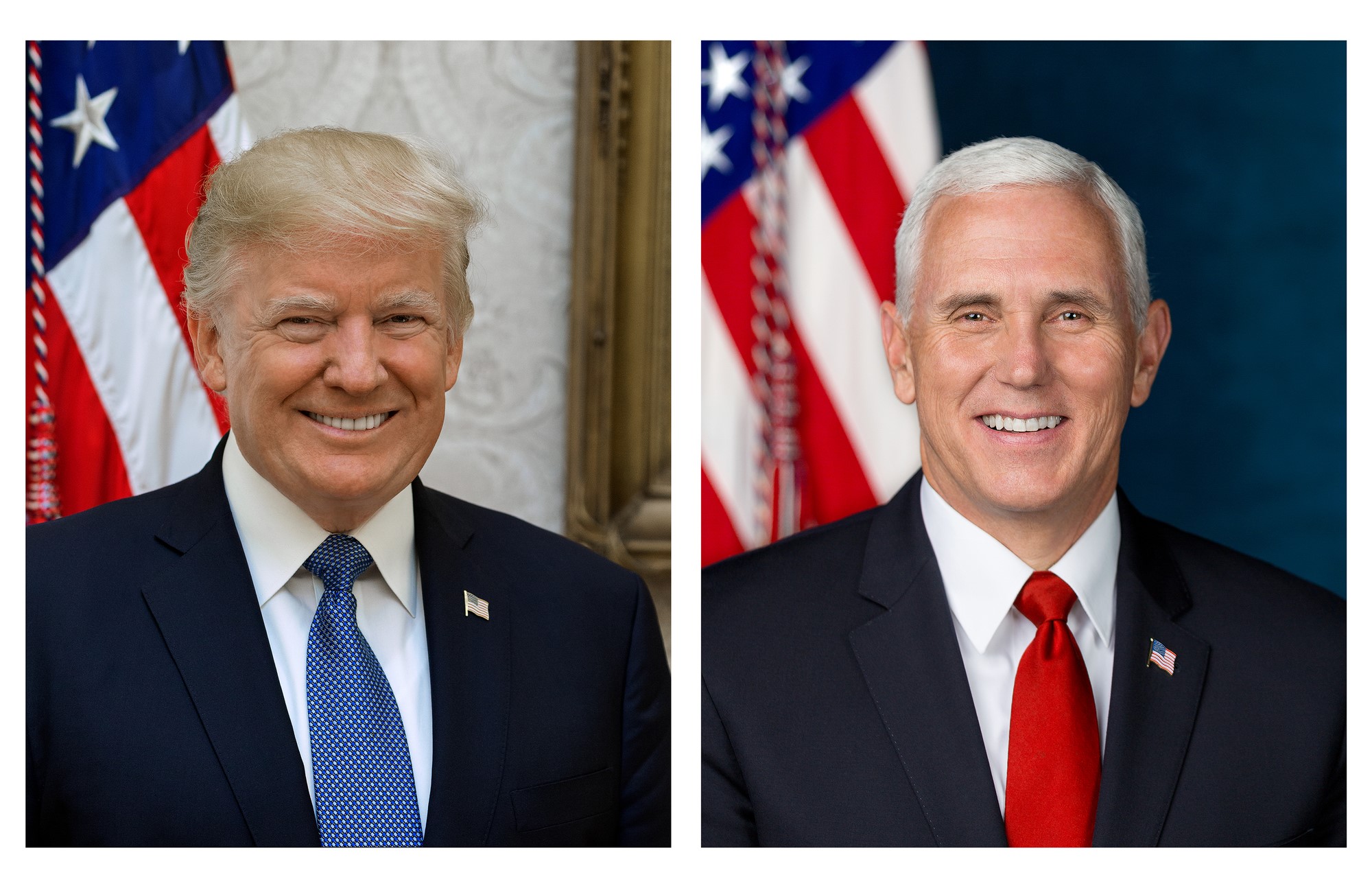
Donald Trump's second and current tenure as the president of the United States began upon his inauguration as the 47th president on January 20, 2025. Trump, a member of the Republican Party who previously served as the 45th president from 2017 to 2021, took office following his victory over the incumbent U.S. vice president, Kamala Harris of the Democratic Party, in the 2024 presidential election. Alongside Trump's presidency, the Republican Party also holds majorities in the U.S. House of Representatives and the U.S. Senate during the 119th Congress.
President Trump signed the Laken Riley Act as the first legislation of his second term. On his first day, Trump pardoned about 1,500 people convicted of offenses in the January 6 Capitol attack of 2021. Within his first month, he signed approximately 70 executive orders (far more than any of his recent predecessors), some of which are being challenged in court. On immigration, he signed executive orders blocking asylum-seekers from entry to the U.S., reinstated the national emergency at the Mexico–U.S. border, designated drug cartels as terrorist organizations, and attempted to end birthright citizenship. Trump established the task force "Department of Government Efficiency" (DOGE), led by the businessman Elon Musk, which is tasked with cutting spending by the federal government, limiting bureaucracy, and which has overseen mass layoffs of civil servants.
In international affairs, Trump withdrew the United States from the World Health Organization and the Paris Climate Accords. He started a trade war with Canada and Mexico and continued the ongoing trade war with China. In April 2025, Trump imposed a 10% tariff on virtually all countries and raised tariffs above 30% on countries such as China and Switzerland, surprising investors and inducing a stock market crash. He has repeatedly expressed interest in annexing Canada, Greenland, and the Panama Canal. In response to the Gaza War, he proposed an American takeover of the Gaza Strip, forcibly relocating the Palestinian population to other Arab states, and rebuilding Gaza into a tourist resort. Amid the Russian invasion of Ukraine, the Trump administration temporarily suspended the provision of intelligence and military aid to Ukraine, offered concessions to Russia, requested half of Ukraine's oil and minerals as repayment for American support, and said that Ukraine bore partial responsibility for the invasion. The administration resumed the aid after Ukraine agreed to a potential ceasefire.
Trump is the second U.S. president to serve non-consecutive terms, and is the oldest person to assume the presidency. Following his victories in the 2016 and 2024 presidential elections, he is not eligible to be elected to a third term due to the provisions of the Twenty-second Amendment to the U.S. Constitution.
Background
First presidency and 2020 presidential election
Trump was inaugurated on January 20, 2017, for his first term as the president of the United States, after winning the 2016 United States presidential election. While in office, Trump signed 220 executive orders. In domestic policy, he signed major legislation like the Tax Cuts and Jobs Act, First Step Act, and the Great American Outdoors Act along with bills for pandemic-era relief. He established the U.S. Space Force, the first new US military branch since 1947. In foreign policy, he withdrew the US from multiple international agreements including trade (the Trans-Pacific Partnership), climate (Paris Climate Agreement), and the Joint Comprehensive Plan of Action (Iran Nuclear Deal). He introduced numerous travel bans on several countries, recognized Jerusalem as the capital of Israel, and sought rapprochement with North Korea. He continued the ongoing War on Terror campaign and the campaign against ISIS. He replaced NAFTA with the USMCA and oversaw the U.S.-Taliban agreement.
Trump was involved in many controversies related to his policies, conduct, and false or misleading statements. These included the Mueller special counsel investigation into his presidential campaign's alleged coordination with the Russian government during the 2016 election, the House of Representatives' impeachment in December 2019 for abuse of power and contempt of Congress after the Trump–Ukraine scandal (culminating in his acquittal by the Senate in February 2020), the family separation policy for illegals detained at the U.S.–Mexico border, limitations on the number of immigrants and refugees permitted from certain countries (many of which were Muslim-majority), demand for federal funding of the Mexico–United States border wall (which resulted in the 2018–2019 government shutdown, the longest federal government shutdown in U.S. history) and attempts to repeal the Affordable Care Act (ACA).
His reelection loss to Joe Biden came amidst a series of crises, including the COVID-19 pandemic and its resulting aftermath, along with numerous protests and riots. In the aftermath of the election, Trump challenged the election results, alleging that widespread electoral fraud had occurred and that he had legitimately won the election. Although most resulting lawsuits were either dismissed or ruled against by numerous courts, Trump nonetheless conspired with his campaign team to submit documents in several states (all of which had been won by Biden) that falsely claimed to be legitimate electoral certificates for President Trump and Vice President Mike Pence. After the submission of these documents, the Trump campaign intended that the presiding officer of the United States Senate, either President of the Senate Pence or President pro tempore Chuck Grassley, would claim to have the unilateral power to reject electors during the January 6, 2021, vote counting session; the presiding officer would reject all electors from the several states in which the Trump campaign had submitted false documents, leaving 232 votes for Trump and 222 votes for Biden, thereby overturning the election results in favor of Trump. The plans for January 6 failed to come to fruition after Pence refused to follow the campaign's proposals. Trump nevertheless urged his supporters on January 6, 2021, to march to the Capitol while the joint session of Congress was assembled there to count electoral votes. The protests turned violent and many stormed the building, interrupting the electoral vote count. As a result, the House impeached Trump for a second time for incitement of insurrection on January 13, 2021, making him the only federal office holder in American history to be impeached more than once. The Senate would later acquit him for the second time on February 13, 2021, after he had already left office.
Between presidencies and 2024 presidential election
Trump announced his candidacy for the nomination of the Republican Party in the 2024 presidential election on November 15, 2022. In March 2024, Trump clinched the nomination. Trump selected Senator JD Vance of Ohio, a former critic of his, as his running mate, and the two were officially nominated at the 2024 Republican National Convention. Prior to the RNC, Trump was the victim of an attempted assassination in Pennsylvania.
Early on November 6, 2024, the day after the election, Trump was projected to have secured the presidency. Trump won the presidential election with 312 electoral votes compared to Kamala Harris' 226. Trump, upon taking office, was the second president in U.S. history to serve non-consecutive terms after Grover Cleveland in 1893, the oldest individual to assume the presidency, and the first convicted felon to serve the presidency following his conviction in May 2024. Vance, as the third-youngest vice president in U.S. history, became the first Millennial vice president. In the concurrent congressional elections, Republicans retained a reduced majority in the House of Representatives and took control of the Senate.
Transition period, inauguration, and first 100 days
The presidential transition period began following Trump's victory in the 2024 U.S. presidential election, though Trump had chosen Linda McMahon and Howard Lutnick to begin planning for the transition in August 2024. According to The New York Times, Trump was "superstitious" and prefers to avoid discussing the presidential transition process until after Election Day. His transition team relied on the work of the America First Policy Institute, rather than The Heritage Foundation, a conservative think tank that garnered controversy during the election for Project 2025, a set of initiatives that would reshape the federal government. By October, he had not participated in the federal presidential transition process, and he had not signed a required ethics pledge, as of November. During the transition period, Trump announced nominations for his cabinet and administration.
Trump was inaugurated at the United States Capitol on January 20, 2025, succeeding Joe Biden as president. He was sworn in by Chief Justice John Roberts. The inauguration occurred indoors in the Capitol Rotunda. Two days before the inauguration, Trump launched a meme coin, $Trump. In his first weeks, several of Trump's actions ignored or violated federal laws, regulations, and the Constitution.
Administration
Cabinet
Trump's cabinet choices were described by news media as valuing personal loyalty over relevant experience, and for having a range of conflicting ideologies and "eclectic personalities". It was also described as the wealthiest administration in modern history, with over 13 billionaires chosen to take government posts. Trump officials and Elon Musk threatened to fund primary challengers in upcoming elections against Republican Senators who did not vote for Trump's nominees. Despite this, three Republicans — Susan Collins, Mitch McConnell, and Lisa Murkowski — have voted against at least one of Trump's nominees; all three voted against U.S. Secretary of Defense Pete Hegseth.
Loyalty tests
Once the second Trump presidency began, White House screening teams fanned out to federal agencies to screen job applicants for their loyalty to the president's agenda. On his first day in office, Trump signed an executive order asserting to restore merit-based federal hiring practices and "dedication to our Constitution". As part of its U.S. federal deferred resignation program, the Trump administration demanded "loyalty" from federal workers. In a break from politically neutral speech, the Justice Department issued memos about "insubordination", "abhorrent conduct" and vowed to pursue opponents of Trump's cost-cutting efforts "to the ends of the Earth" in what was described by current and former law enforcement officials as a campaign of intimidation against agents insufficiently loyal to Trump. Candidates for top national intelligence and law enforcement positions were given Trump loyalty tests. Candidates were asked to give yes or no responses to whether or not January 6 was an "inside job" and whether or not the 2020 election was "stolen". Those that did not say yes to both answers were not hired.
Actions against political opponents and the media
Trump frequently promised to exact retribution against perceived political enemies through his 2024 campaign, and has said he has "every right" to go after political opponents. Trump has repeatedly suggested that he supports outlawing political dissent that he regards as misleading or that questions the legitimacy of his presidency, for example saying that criticism of judges who ruled in favor of him "should be punishable by very serious fines and beyond that." He has also repeatedly called for press companies who have produced unfavorable coverage of him to have their licenses revoked, and has said that he will jail reporters who refuse to name the sources of leaks. The New York Times described Trump as using "grievance as a political tool, portraying himself as the victim of what he claims is a powerful and amorphous 'deep state.'"
Trump was described as seeking revenge after making a series of retaliatory actions against perceived opponents upon taking office and intimidating those who would cross him in the future.
Pulling security protection and clearances
Trump revoked the security protection for his former Secretary of State Mike Pompeo, his aide Brian Hook, and John Bolton, who all had faced assassination threats from Iran. The revocation of security protection was described as part of Trump's vow to target those he perceives as adversaries. He also revoked protection for Anthony Fauci who had received several death threats, and said to reporters that he would not feel any responsibility if harm befell the former government officials he revoked security details from.
On January 29, Defense Secretary Pete Hegseth suspended former Chair of the Joint Chiefs Mark Milley's security clearance, withdrew the authorization for his security detail, and ordered a review of his actions as Chair of the Joint Chiefs of Staff with a view to demote him in rank. Hours after Trump was inaugurated, the official portrait of General Milley was removed from a Pentagon hallway where the portraits of all former chairmen are displayed.
Within 24 hours of being elected, Trump revoked the security clearances of 50 officials who signed onto a letter about the Hunter Biden laptop controversy as well as John Bolton, ex-DNI Director James Clapper and ex-CIA Directors John Brennan and Leon Panetta.
Justice Department investigations
Trump used the Justice Department to punish his enemies and reward his allies while making unfounded claims of prior "weaponization" against him. Trump ordered the attorney general to investigate the Biden administration for "weaponization of the federal government" and "government censorship of speech". The Guardian described the investigations as "politically charged reviews into his personal grievances". The orders made misleading accusations against the Biden administration and asserted they had committed criminal conduct against him and his supporters and demanded evidence be found to "correct past misconduct". He threatened, signed executive actions, and ordered investigations into his political opponents, critics, and organizations aligned with the Democratic Party.
On January 27, the Justice Department fired more than a dozen officials who worked on criminal cases against Trump alleging a lack of trust in faithfully executing his agenda. It also announced a "special project" to investigate prosecutors who had previously brought charges against January 6 rioters, and launched a "weaponization working group" to review and investigate officials at both the state and federal levels who previously investigated Trump and provide the White House quarterly reports on its findings. Several FBI agents and the FBI Agents Association sued the Trump administration to prevent the publication of the names of 5,000 FBI agents for their involvement in investigating the January 6 attack, and Trump later said he would fire some agents involved in investigating the attack.
It was reported on February 14 that the efforts by Trump to dismiss the case into New York City Mayor Eric Adams, which caused the resignation of seven government prosecutors, came in the same week as the administration was negotiating with the mayor over immigration enforcement initiatives and Trump's "border czar" Tom Homan made reference to an "agreement". Earlier, Adams had agreed with Homan to give access to the city's Rikers Island jail for ICE without—via a "loophole ... [Adams] appears to have found"—violating the city’s sanctuary laws, and joined Homan in a joint interview conducted by Dr. Phil McGraw, among one or more other joint interviews.
The report came after February 10, 2025, when the Department of Justice under Trump instructed federal prosecutors to drop charges against Adams, citing concerns that the case had been affected by publicity and was interfering with his ability to govern. The memo directing this move, written by acting Deputy Attorney General Emil Bove, stated that the prosecution had limited Adams' capacity to focus on issues such as immigration and crime. The Justice Department's decision did not assess the strength of the evidence or legal arguments in the case. The memo was issued months before the city's Democratic primary, where Adams is seeking reelection. The charges were to be dropped "as soon as is practicable" pending a further review of Adams' case following the general election in November 2025. Danielle Sassoon, the US Attorney in charge of the case, refused to dismiss the charges, telling Attorney General Pam Bondi that "I cannot agree to seek a dismissal driven by improper considerations". Sassoon later resigned, accusing Bove and the Trump administration of making an illicit deal with Adams to dismiss the charges, becoming the first of seven prosecutors to resign due to the order to dismiss charges.
In March 2025, interim US Attorney Ed Martin sent a letter to US Representative Eugene Vindman requesting information about his business dealings. Martin also sent letters to senator Chuck Schumer and representative Robert Garcia, suggesting that they had threatened officials, and to William Treanor, dean of Georgetown University's law school, warning that the law school's students would not be eligible for employment or fellowships with the District of Columbia's US Attorney's office as long as the school discussed diversity, equity and inclusion.
Actions against the media
Following his reelection, Trump launched lawsuits and created blacklists against certain media outlets, and took over the process run by the White House Correspondents' Association to choose what outlets could gain access to him. On January 22, Trump's FCC chair Brendan Carr revived three investigations into claims of bias from CBS, ABC, and NBC, but not Fox News, and Carr previously promised to punish news broadcasters he saw as unfair to Trump or Republicans in general. On January 29, Carr ordered an investigation into underwriting announcements on NPR and PBS stations, and recommended that Congress stop funding these organizations (which aligns with the section of Project 2025 that Carr had authored). In his first-term budgets, Trump had previously proposed eliminating funding for public broadcasting, art, libraries, and museums. Carr sent a letter to the heads of NPR and PBS with his complaints, but ignored requests for a copy from a Democratic FCC commissioner. On February 12, Carr launched investigations into Comcast, the parent company of NBC News and Universal Studios, over having diversity, equity, and inclusion programs.
In February 2025, Associated Press journalists were prevented from covering several events in the White House after the Trump administration objected to the Associated Press using the name "Gulf of Mexico" instead of "Gulf of America" as chosen by Trump. The Associated Press had recommended both names were to be used, as "Mexico, as well as other countries and international bodies, do not have to recognize the name change", and "the Gulf of Mexico has carried that name for more than 400 years." The Associated Press protested the Trump administration's action as violating the First Amendment to the United States Constitution, while White House Press Secretary Karoline Leavitt later commented: "If we feel that there are lies being pushed by outlets in this room, we are going to hold those lies accountable", as she described the name of 'Gulf of America' as a "fact". The administration followed up by banning Associated Press journalists indefinitely from the Oval Office and Air Force One, citing the gulf naming issue. Trump said that month that the Associated Press would continue to be banned "until such time as they agree that it's the Gulf of America". Associated Press filed a lawsuit on February 21, in which it states "The press and all people in the United States have the right to choose their own words and not be retaliated against by the government, [...] The Constitution does not allow the government to control speech. Allowing such government control and retaliation to stand is a threat to every American's freedom."
On April 8, 2025, Federal District Judge Trevor McFadden granted the preliminary injunction sought by AP and ruled that the White House must lift the access restrictions they have imposed on The Associated Press while the AP v. Budowich lawsuit moves forward.
Actions against the legal profession
In March 2025, Trump said that he would be targeting law firms, a move experts call unprecedented. He first ordered that security clearances be revoked for all of the attorneys at Covington & Burling who are involved in the firm's representation of former special counsel Jack Smith. Smith led federal investigations and prosecutions of Trump in both an election obstruction case and a classified documents case. Trump then signed executive orders 14230 and 14237, each aimed at another firm. The first ordered that the security clearances of all Perkins Coie employees be suspended, and also prohibited the firm from receiving money from federal contractors and barred its attorneys from entering federal buildings. Perkins Coie had represented Hillary Clinton in her 2016 presidential campaign, and in that capacity paid for opposition research that led to the Steele dossier. The second involved similar orders for the firm Paul, Weiss, Rifkind, Wharton & Garrison (known as Paul, Weiss), and for Mark Pomerantz, a previous partner at the firm. Pomerantz had worked with the Manhattan district attorney's office, which subsquently prosecuted Trump for falsifying business records. The firm had done pro bono work in January 6 cases. Trump subsequently rescinded order 14237 after Paul, Weiss agreed to a set of conditions, such as promising to provide $40 million in free legal services to the administration and end its diversity policies. Within days, Trump issued executive order 14246, this time aimed at Jenner & Block, a firm that employed Andrew Weissmann after he worked on the Mueller special counsel investigation. Two days later, Trump issued another executive order directed at Wilmer Cutler Pickering Hale and Dorr (known as WilmerHale), where Robert Mueller had been a partner; the firm also employed Aaron Zebley and James Quarles, who had worked with the Mueller special counsel investigation.
Claire Finkelstein, a law professor at the University of Pennsylvania, said the goal of these executive orders was to "intimidate professionals, to intimidate the legal profession from engaging in professional activities that go against Donald Trump and the current administration."
Perkins Coie filed a lawsuit challenging executive order 14230, and on March 12, Judge Beryl Howell of the US District Court for the District of Columbia issued a temporary restraining order for parts of Trump's executive order. Howell said that the order likely violated several constitutional amendments and "casts a chilling harm of blizzard proportion across the entire legal profession". The Department of Justice attempted to have Howell removed from the case, alleging that she is "insufficiently impartial", but the motion was denied. On March 28, Jenner & Block and WilmerHale also filed suit in the District of Columbia challenging their respective executive orders. The same day, Judge John Bates issued a temporary restraining order for the executive order directed at Jenner & Block, and Judge Richard Leon issued a temporary restraining order for the executive order directed at WilmerHale.
Trump also issued a presidential memorandum, "Preventing Abuses of the Legal System and the Federal Court", targeting lawyers and law firms more generally if they filed "frivolous, unreasonable, and vexatious litigation" against the administration, as judged by the attorney general. The menacing memo, again including revocation of security clearances and preventing any company that uses such a firm from getting federal contracts, has been seen as a threatening escalation and broadening of the president's campaign of retaliation against judges and lawyers who don't share his political views. A variety of people in the legal profession condemned the memorandum as an attempt to intimidate firms so that they wouldn't take on clients who oppose government actions. The Equal Employment Opportunity Commission also contacted 20 law firms, telling them that they were being investigated in relation to their diversity, equity, and inclusion (DEI) practices.
The series of actions against lawyers and law firms quickly started having the desired effect of making it harder for those who oppose Trump administration actions to find lawyers who would agree to represent them. UCLA Law professor Scott Cummings and a former senior Justice Department official have both called Trump's moves attacking law firms and targeting lawyers "authoritarian". Senior attorney for the ACLU Ben Wizner said Trump's threats are an attempt to "chill and intimidate" lawyers who challenge him. In remarks delivered with the Governor of Louisiana, President Trump told reporters that he thinks "The law firms have to behave themselves, and we've proven that."
Within the legal community, there have been varied responses to Trump's attacks on the profession. Law firms that haven't been targeted by Trump have largely been silent in response. A few firms have issued public statements, such as Albert Sellars LLP, whose response was a concise "Fuck that fascist nonsense." The American Bar Association released a statement encouraging everyone in the profession to stand up against the Trump's "efforts to undermine the courts and the legal profession", following that with another statement joined by over 50 smaller bar associations across the country. The deans of nearly 80 law schools from across the country also signed a joint letter condemning the administration's actions, stating that "Punishing lawyers for their representation and advocacy violates the First Amendment and undermines the Sixth Amendment." Democratic state attorneys general sent a joint letter as well, condemning Trump's attempts to undermine the rule of law. Rachel Cohen, an associate at Skadden, Arps, Slate, Meagher & Flom (also known as Skadden) organized an open letter, inviting other associates to sign on. The letter, addressed to large law firms, called on them to take a stand, and as of March 27, 2025 over 1500 associates had signed it. Cohen also submitted a conditional resignation letter, calling on Skadden to fight Trump's actions, and they let her go the same day. Skadden later proactively approached the Trump administration before Trump targeted them with an executive order, coming to an agreement with the administration along the same lines as that reached by Paul, Weiss.
Actions against higher education
Trump and the Republican Party advocated for new laws and pursued policies to crack down on campus curriculum, protests, political expression, and speakers that attempted to sidestep the Constitution's free speech protections.
In March 2025, the administration stated that it was cancelling $400 million in federal funding to Columbia University "due to the school’s continued inaction in the face of persistent harassment of Jewish students", and "other alleged violations of Title VI and Title VII of the Civil Rights Act of 1964." The administration subsequently made multiple demands, including that the university place its Middle Eastern, South Asian, and African Studies Department under academic receivership, that it suspend or expel students who had participated in Columbia's 2024 pro-Palestinian campus occupations, and that it change admissions policies. Several academic associations condemned the Trump administration's actions as an attack on academic freedom.
Forty-one members of Columbia's history department wrote the university's president and board of trustees, noting that "authoritarian regimes always seek to gain control over independent academic institutions" and should be resisted. The university's chapter of the American Association of University Professors likewise urged it to resist, describing the government's demands as "a ransom letter" and saying that the "assault on Columbia will serve as a model for attacks on other universities across the nation". Other academics, including Christopher Eisgruber, Austin Sarat, and Steven Levistky and Ryan Enos, wrote columns, again arguing that this was just the first step in a broader attack on higher education, and calling for action from institutions and the public at large. Levitsky, co-author of How Democracies Die, says that "It is really common for authoritarian governments – both those on the left and those on the right – to go after universities".
Trump arrested a 30-year-old lawful permanent resident and Columbia University student Mahmoud Khalil, and said he would deport him and others who took part in protests for alleged antisemitism. The move was described by legal experts as a violation of the First Amendment and serving a chilling effect against dissent more broadly. He also deported kidney transplant specialist and Brown University professor Dr. Rasha Alawieh in defiance of a court order, and denied entry to a French scientist after messages critical of Trump were found on his phone.
The Department of Education’s Office for Civil Rights contacted 60 additional colleges and universities, saying that it had initiated investigations and again invoking alleged violations “relating to antisemitic harassment and discrimination”. A group of approximately 400 Jewish faculty and students from across the country responded with a letter saying that they were united in their refusal "to let our Jewish identities be used as a pretext for destroying institutions that have long made America great."
The Trump administration pursued actions against Princeton by stripping federal grants over allegations that the élite university hadn't done enough to comply with the administration's priorities, such as not doing enough in response to antisemitic discrimination. On March 31, the board of the Association of American Universities stated that stopping research funding “for reasons unrelated to research sets a dangerous and counterproductive precedent.”
Executive orders
Trump began office with the most executive orders ever signed on the first day of a United States presidential term, at 26 executive orders. Following behind Trump's executive order tally is Joe Biden at 9 executive orders on January 20, 2021, then Barack Obama at 2 executive orders, and Bill Clinton at 1 executive order.
Trump's signing of executive orders was described as a "shock and awe" campaign that tested the limits of executive authority. Four days into Trump's second term, analysis conducted by Time found that nearly two-thirds of his executive actions "mirror or partially mirror" proposals from Project 2025, which was seconded with analysis from Bloomberg Government.
The signing of many of Trump's executive orders are being challenged in court, as the executive orders are affecting federal funding, federal employee status, immigration, federal programs, government data availability, and more. The majority of the cases are being filed in response to executive orders related to the establishment of the Department of Government Efficiency, Executive Order 14158, and the actions taken by Elon Musk and the DOGE team towards federal agencies as self-identified cost-cutting measures.
Domestic policy
Prospective policies for Trump's second presidency were proposed in Agenda 47, a collection of his formal policy plans.
Abortion
Before being elected, Trump had declared that abortion should be delegated to states in April 2024. To that extent, he stated he would allow states to monitor pregnancies and criminally charge abortion patients. Trump criticized the Arizona Supreme Court's ruling in Planned Parenthood Arizona v. Mayes (2024), in which the court upheld an 1864 law criminalizing abortions except to save the life of the mother, stating that he would not sign a federal abortion ban and reaffirmed his position in October.
After the Alabama Supreme Court ruled in LePage v. Center for Reproductive Medicine (2024) that frozen embryos are living beings, Trump positioned himself in favor of in vitro fertilisation (IVF).
On January 24, 2025, during the first week of his second term as president, Trump reinstated the Mexico City policy, which had been rescinded by the Biden administration.
On February 19, 2025, Trump signed an executive order to expand access to and reduce the costs of IVF.
Climate and environment
At a private dinner at Mar-a-Lago in April 2024, Trump encouraged fossil fuel companies to donate to his campaign, saying that he would roll back environmental regulations if elected.
Trump's transition team for climate and the environment was led by David Bernhardt, a former oil lobbyist who served as interior secretary, and Andrew R. Wheeler, a former coal lobbyist who led the EPA under Trump. The team prepared to withdraw from the Paris Agreement for a second time, expand drilling and mining on public land, and dismantle offices working to end pollution. Trump pledged to redraw the boundaries of the Bears Ears and Grand Staircase–Escalante National Monuments as he did in his first term, end a pause on new natural gas export terminals that began under President Joe Biden, and prevent states from setting their own pollution standards.
Upon taking office, Trump appointed oil, gas, and chemical lobbyists to the Environmental Protection Agency to roll back climate rules and pollution controls. Trump ordered the pause on disbursement of climate-related funds issued by the IRA and BIL, and falsely conflated the funds with the "Green New Deal".
In February 2025, the FBI, Treasury Department, and EPA requested that Citibank freeze bank accounts of nonprofit organizations that received funding under the Greenhouse Gas Reduction Fund, created by Congress in 2022 as part of the Inflation Reduction Act. Citibank froze the accounts. The FBI also asked Citibank to freeze accounts of Habitat for Humanity, United Way, the Colorado Clean Energy Fund and the New York State Department of Taxation and Finance. Three nonprofit organizations challenged the actions in court.
Criminal justice and law enforcement
Trump entered office following 2024's 50-year record-low level of violent crime. The Associated Press reported that despite historic drops in crime, many voters felt unsafe due to "misleading campaign rhetoric".
Upon taking office, Trump issued an executive order to resume and pursue executions for criminal cases, and the Justice Department put a freeze on civil rights cases and signaled it would roll back consent agreements with police departments. A New York Times analysis described Trump's conflicting policies and pardons towards criminal justice as sending a message of "backing the blue" as long as they backed him.
The National Law Enforcement Accountability Database (which kept disciplinary records of federal law enforcement officers) was deactivated in January 2025; it was proposed by Trump in 2020 and created by Biden in 2023. Separately, Elon Musk's private bodyguards were assigned as special deputies by the United States Marshals Service, reported CNN and CBS News in February 2025.
Presidential pardons and commutations
During the transition period, Trump was expected to end the Department of Justice's prosecutions against him in Washington, D.C., and Florida. According to The Washington Post, Special Counsel Jack Smith considered ending his prosecutions early and submitting a final report to Attorney General Merrick Garland before Trump was inaugurated. The final report was submitted on January 7, 2025, with no charges being brought to trial against Trump.
Upon assuming the presidency again on January 20, 2025, Trump issued a blanket mass pardon for those charged with the January 6 Capitol Riot. During his campaign for re-election, Trump had said multiple times that if he were reelected in 2024, he would pardon the rioters. The pardon commuted the prison sentences of 14 people by name, effected the release of over 200 others also in prison, and pardoned the more than 1,550 people who had been criminally charged. 500 people had been sentenced to prison terms and 1,358 had been criminally charged. Following Trump's grant of clemency to all January 6 rioters, on January 22, House Speaker Mike Johnson announced a formation of a panel to investigate the January 6 committee in what the Associated Press described as "an effort to defend Trump's actions that day and dispute the work of a bipartisan committee that investigated the siege two years ago".
In May 2024 at the Libertarian National Convention, Trump said that he would commute Ross Ulbricht's sentence on his first day in office. Since 2015, Ulbricht had been serving a life sentence for charges related to creating and operating the darknet market website Silk Road, which operated as a hidden service on the Tor network and facilitated the sale of narcotics and other illegal products and services. On January 21, 2025, Trump issued a full and unconditional pardon to Ross Ulbricht, fulfilling a campaign promise.
On January 23, 2025, Trump granted pardons to 23 anti-abortion protestors. Among the 23 pardoned were Lauren Handy and 9 of her co-defendants, who were involved in the October 2020 blockade of a Washington, DC abortion clinic, and later convicted in violation of the Freedom of Access to Clinic Entrances Act.
Trump has also floated or hinted at issuing potential pardons for Julian Assange and Peter Navarro; media outlets have also speculated that Trump may issue pardons for Eric Adams and Todd and Julie Chrisley.
Trump in March 2025 wrote on social media that President Joe Biden's pardons of lawmakers who investigated the January 6 attack were now "void, vacant, and of no further force of effect", as Trump stated that these pardons were signed by autopen. In 2024, the Fourth Circuit Court of Appeals ruled that pardons do not have to be in writing.
Diversity, equity and inclusion
In January 2025, President Trump signed executive orders aimed at terminating DEI practices and another aimed at transgender issues.
At a press conference held in January 2025, the day after a mid-air collision between an airplane and helicopter that killed 67 people, Trump said, "the FAA is actively recruiting workers who suffer severe intellectual disabilities, psychiatric problems and other mental and physical conditions under a diversity and inclusion hiring initiative spelled out on the agency's website."
In response to anti-DEI executive actions, numerous agencies and websites altered or removed material related to women, racial minorities, and transgender individuals. The National Park Service removed mentions of transgender individuals from its website on the Stonewall riots, changed "LGBT" to "LGB", and removed the word "queer". The National Cryptologic Museum papered over portraits of women and racial minorities in their Hall of Honor, including those of Elizabeth Friedman, Washington Wong, and Ralph W. Adams Jr. The portraits were restored after news of the actions began circulating online. Pictures that celebrated women in science were removed from NASA buildings.
Economy
Trump inherited a resilient economy from the Biden administration, with increasing economic growth, low unemployment, and declining inflation. When Trump assumed office in January 2025, the seasonally adjusted unemployment rate was 4%, and the inflation rate, measured by the Personal Consumption Expenditure price index, was projected to range between 2.2% and 2.4% for 2025. The New York Times and Economic Policy Institute described the economy as "in better shape than that bequeathed to any newly elected president since George W. Bush came into office in 2001". However, polls found that many Americans still felt the impacts of the 2021–2023 inflation surge, which partly contributed to Trump's reelection win.
In a March 2025 media interview, Trump was asked if he expected a recession to occur in 2025, to which he answered: "I hate to predict things like that. There is a period of transition, because what we’re doing is very big." By that month, the Trump administration shut down the Federal Economic Statistics Advisory Committee and the Bureau of Economic Analysis Advisory Committee, both of which calculated economic data and had operated for over 20 years. On March 13, 2025, the S&P 500 index entered into a correction, that is it dropped 10% from its peak on February 19, 2025. The drop came amidst what the Associated Press called "historic" jumps in public anxiety caused by Trump's tariff threats, with large drops in consumer sentiment and increased expectations of higher inflation rates among consumers and Wall Street economists. Markets dropped substantially in early April 2025 following Trump's imposition of tariffs on nearly all countries in the world and prompted retaliation from trade partners that triggered a stock market crash.
Cryptocurrency
During his 2024 campaign, Trump promised to fire Gary Gensler, immediately shut down Operation Chokepoint 2.0 (an alleged anti-crypto conspiracy), make the United States the “crypto capital of the planet” and said, "The rules will be written by people who love your industry, not hate your industry". Following Trump's elections Bitcoin hit a record high. Axios estimated that the $Trump currency "accounts for about 89% of Donald Trump's net worth".
After taking office, during what the New York Times described as, "a first-of-its-kind “crypto summit", Trump said, “I promised to make America the Bitcoin superpower of the world”. During the summit, David O. Sacks the "White House A.I. & Crypto Czar" said that the crypto industry had been "subjected to prosecution and persecution”. According to The Intercept, those at the summit represented over "$11 million in donations to Trump’s inaugural committee".
The Securities and Exchange Commission (SEC) under Trump filed to dismiss its lawsuit against Coinbase which had charged Coinbase was, "Operating as an Unregistered Securities Exchange, Broker, and Clearing Agency". The SEC requested a 60-day pause, in its lawsuit against Binance alleging "Binance mishandled funds and violated securities laws". The SEC asked that the case against Trump associate Justin Sun be put on hold. The SEC said it would not exercise any regulatory authority over memecoins.
Representative Ayanna Pressley criticized the Trump administration and Department of Government Efficiencys targeting of the Consumer Financial Protection Bureau and "emphasized the critical role" of the agencies work to protect consumers of cryptocurrencies. Trump nominated Paul S. Atkins, who has "close ties to the crypto industry", to succeed Gary Gensler as Chair of the Securities and Exchange Commission. Scott Bessent, described by Forbes as, "a prominent pro-crypto hedge fund manager", was nominated by Trump for Secretary of the Treasury. ProPublica reported that the Department of Housing and Urban Development had discussed using cryptocurrency, which was described as "simply reckless" by Reps. Maxine Waters, Stephen Lynch and Emanuel Cleaver who drew comparisons with "risky, unregulated, and predatory financial products" that led to the Great Recession. Trump's ties to cryptocurrency have led to concerns of corruption.
In March 2025, Trump established the Strategic bitcoin reserve and pardoned BitMEX (the first presidential pardon of a corporation).
Taxation and deficits
In January 2025, Republicans began considering cuts for various social programs in order to pay for the proposed tax cuts. The Congressional Budget Office estimated in January 2025 that extending the 2017 Trump tax cuts could increase deficits by more than $4 trillion over 10 years, if not offset by spending cuts. Trump's campaign proposals to exempt Social Security benefits, tip and overtime income from taxation would further increase deficits. The Committee for a Responsible Federal Budget estimated that all of Trump's tax cut proposals together would reduce federal tax receipts by $5 trillion to $11 trillion over a decade, if not offset. Some congressional Republicans argued the tax cuts would not increase deficits.
Trump, with the help of Elon Musk, launched a campaign to reduce the federal workforce by thousands of employees, primarily focusing on probationary staff, to streamline government operations. This has sparked criticism over the potential disruption of vital services and raised concerns about employee rights, with legal challenges and internal dissent emerging.
Tariffs policy
During his 2024 campaign, Trump promised to impose higher tariffs on imports from all countries, particularly China. On November 25, 2024, following his election victory, Trump said he would sign an executive order placing 25% tariffs on Canada and Mexico, and impose an additional 10% tariff to China. On November 30, 2024, Trump threatened to impose a 100% tariff to BRICS nations if they tried to create a new BRICS currency or promote another currency to replace the U.S. dollar as the global reserve currency.
On February 1, 2025, after taking office the month prior, Trump followed through on his intentions and signed three executive orders imposing a 25% tariff on all goods from Mexico and Canada and a 10% tariff on China, originally due to take effect on February 4. A lower 10% tariff was announced for all energy exports from Canada, including electricity, natural gas, and oil. Trump's trade advisor, Peter Navarro, stated that the lower rate for energy was intended to "minimize any disruptive effects". In response, representatives from Mexico and Canada announced intentions to impose retaliatory tariffs on the United States, which if implemented could lead to an increase in tariff rates in accordance with a clause reportedly included in the orders signed by Trump. On February 3, Trump announced that the tariffs on both Mexico and Canada would be paused for one month after the countries agreed to take further steps to prevent the trafficking of drugs into the United States.
According to Kim Clausing of the Peterson Institute for International Economics, the proposed tariffs on Canada, Mexico, and China would represent the "largest tax increase [in the United States] since the 1990s."
On April 2, a day Trump nicknamed "Liberation Day", Trump announced a 10% universal import duty on all goods brought into the US and even higher rates for 57 trading partners. In response, markets sunk sharply lower.
Education
During his first term, Trump cut funding to the Department of Education, while continuing to criticize it. During his 2024 campaign, Trump actively promoted the idea of abolishing the Department of Education and proposed handing over control of education to individual state governments.
On January 21, 2025, the Department of Homeland Security announced it would no longer refrain from arresting illegal immigrants in schools.
Emergency management
Just before the Los Angeles fires were contained, the United States Army Corps of Engineers started releasing water from federal reservoirs in California's Lake Success and Lake Kaweah via the Schafer Dam and Terminus Dam respectively, for a total of 2.2 billion gallons of water per local authorities. The Army Corps initially stated that the water was for California to "respond to the wildfires", following an executive order by Trump. However, the Army Corps later stated that the released water "could not be delivered to Southern California directly", that other government agencies said they "likely could not utilize the additional water with such short notice", and that the water release was stopped after "elected officials expressed concerns from their constituents about potential flooding of downstream lands".
In February 2025, Trump signed a pair of executive orders blocking FEMA funds from being used to help undocumented immigrants in “sanctuary cities.” This had the consequence of freezing billions of dollars in disaster grants, which were funding rebuilding efforts for communities struck by Hurricane Helene. In April 2025, the Federal Emergency Management Agency (FEMA) under Trump has denied North Carolina's request to extend the full reimbursement period for Hurricane Helene recovery efforts. The Trump administration also turned down a request from Georgia Gov. Brian Kemp for a second deadline extension to apply for relief from the state following Hurricane Helene in March 2025.
Federal government and executive power
The second Trump administration has pursued a maximalist interpretation of the unitary executive theory. It has been noted for making sweeping assertions of executive authority, and challenging several Congressional laws and parts of the Constitution restraining presidential power. He issued an executive order to take control of independent federal agencies such as the FCC, FEC, and SEC, attacked journalists and media organizations whose coverage he disliked, placed loyalists in charge of the military and FBI, used the Department of Justice to promote his political interests, and suggested defying court orders and impeaching justices who ruled against him.
On February 15, 2025, Trump wrote on Truth Social and X: "He who saves his Country does not violate any Law", which the White House later reposted on X that day. Shortly afterward on February 19 in a post about congestion pricing in New York, Trump compared himself to a king by saying "LONG LIVE THE KING!". Later that month, Trump told the Governor of Maine, Janet Mills, to "comply" with his executive order banning transgender athletes from women's sports, or he would withdraw "any federal funding", because "we are the federal law".
Also in February 2025, Elon Musk declared that "all federal employees will shortly receive an email requesting to understand what they got done last week ... Failure to respond will be taken as a resignation"; within hours federal employees received an email from the United States Office of Personnel Management demanding their response, within two days, on work done last week.
In March 2025, senior Trump administration officials used the Signal private messaging service to discuss imminent military operations against the Houthis in Yemen, which led to the United States government group chat leak when Jeffrey Goldberg, the editor-in-chief of the American magazine The Atlantic, was added to the chat by Michael Waltz, the national security advisor. The Atlantic reported on and published details of the chat, showing that defense secretary Pete Hegseth used the chat to share details of the impending strikes, including the launch times of F-18 aircraft, MQ-9 drones and Tomahawk missiles, as well as the time when the F-18 aircraft would reach their targets, and the time when the bombs would land. Some of the chat's other members were vice president JD Vance, director of national intelligence Tulsi Gabbard, and CIA director John Ratcliffe. The incident raised several issues, including the Trump administration officials' use of a non-government communication system and the potential transmission of classified information on it, as well as Signal's automatic deletion of chat logs contradicting with the requirement to preserve government records.
DOGE (Department of Government Efficiency)
The Trump administration established the Department of Government Efficiency (DOGE), a temporary organization with Elon Musk as its administrator, and renamed the United States Digital Service to the United States DOGE Service to function as a parent agency. DOGE is a unit tasked with recommending cost-cutting measures, and according to the executive order that established it, its formal purpose is to "modernize federal technology and software to maximize governmental efficiency and productivity".
In late January 2025, Wired reported that the top ranks of the human resources-focused United States Office of Personnel Management (OPM) had been filled by new hires who had formerly worked for either Elon Musk, Peter Thiel, Republican politicians or right-wing media outlets, while Musk's allies were installed into the technology-focused General Services Administration and planned massive spending cuts. On January 28, the OPM offered a "deferred resignation" scheme to federal government employees to announce their resignation by February 6, while stating that employees who resigned would still receive salary and benefits until September 30, 2025. The offer made was similar to Elon Musk's notice to employees after he took control of Twitter. On January 31, Trump added that he would nullify federal employee union contracts, specifically including one with the Education Department, that had been agreed to late in Biden's term. Musk also gained access to the Treasury's payment system. Two OPM officials told Reuters that Musk's allies locked some OPM officials from accessing OPM data systems, with one official saying this enabled Musk's allies to use the systems without oversight. It was reported that this gave DOGE "full access" to the major U.S. Treasury database controlling the expenditure of 6 trillion dollars, as well as "the sensitive personal data of millions of Americans as well as details of public contractors who compete directly with Musk’s own businesses." It was reported that the previous top civil servant who was associated with the database was placed on leave and then resigned after objecting to DOGE's access. It was reported that this access could allow Musk to block payments by the U.S. government to many federal programs. Senator Ron Wyden stated that this access was a "national security risk."
On March 21, Elon Musk visited the Pentagon. This was originally scheduled to be a non-classified briefing on China with the Joint Chiefs. However, seemingly after the New York Times reported the previous day on possible Musk conflicts-of-interest due to business interests in China, this was changed to a meeting with Secretary of Defense Hegseth on efficiency. President Trump said, “Elon has businesses in China, and he would be susceptible perhaps to that. But it was such a fake story.” Musk said he wants to find those who leaked details about this meeting ahead of time.
Mass layoffs
Trump oversaw mass firings of federal workers at various agencies, many of them described as breaking with precedent or federal law and with the intent to replace them with workers more aligned with Trump's agenda.
On January 24, 2025, less than a week into Trump's second presidency, he fired 17 independent inspectors general at federal agencies, which appeared to violate federal law that requires advance notice of dismissals to both chambers of congress with reasons given 30 days in advance. Trump also fired all Democratic but not Republican members of the Privacy and Civil Liberties Oversight Board, which would prevent the board from meeting quorum and functioning. Trump also fired members of the Equal Employment Opportunity Commission, National Labor Relations Board, over 160 members of the National Security Council for not aligning with his agenda, and 56 senior officials at USAID for allegedly attempting to thwart his priorities.
The New York Times reported in January 2025 that the White House might be hoping the firings would be challenged in court, ultimately the Supreme Court, as test cases to invoke the unitary executive theory to give the president exclusive control of the executive branch. The Republican-appointed supermajority on the Court had in recent years indicated support for the theory, which had also been promoted by Project 2025.
On the first day of his second term in January 2025, Trump named a Republican as acting chair of the United States Merit Systems Protection Board. In February 2025, Trump removed a Democratic member of the board, Cathy Harris, who had served three years of her term, and demoted the other Democratic member. Harris then sued the Trump administration, alleging that her removal was illegal. On March 4, 2025, a U.S. District judge, citing U.S. Supreme Court cases from 1933 and 1953, entered a permanent injunction ordering that she be reinstated.
Lawsuits
On March 13, Federal Judge William Alsup of San Francisco ordered that fired employees must be re-hired at the Department of Veterans Affairs, Department of Agriculture, Department of Defense, the Department of Energy, Department of Interior, and Department of Treasury. He ruled that blanket claims of poor performance cannot be used as a “gimmick” to get around the Reduction in Force Act, and stated that “it is a sad day when our government would fire some good employee and say it was based on performance when they know good and well that's a lie.” The Ninth Circuit Court rejected the Trump administration's appeal for them to stay Alsup's ruling, with the appeals court stating that a stay "would not preserve the status quo. It would do just the opposite — it would disrupt the status quo and turn it on its head".
In a second lawsuit also on March 13, Federal Judge James Bredar of Maryland issued a broader order that the Trump administration must re-hire workers who had been fired from 12 departments and 6 agencies. This was the result of a lawsuit brought by 19 states and the District of Columbia that they had not been given the legally-required advance notice of large layoffs. And that the reason of “performance” was not true. Judge Bredar wrote, “There were no individualized assessments of employees. They were all just fired. Collectively.”
The Trump administration is both appealing this second decision and complying with it in the meantime. Twenty-four thousand employees are in the process of being re-hired, with most being placed on administrative leave with full pay and benefits as the in-between step. The re-hires include 6,400 employees at the IRS, 5,700 employees at the Department of Agriculture, 3,200 employees at the Department of Health and Human Services, and 1,700 employees at the Department of Veteran's Affairs, with all these numbers being rounded to the nearest hundred.
Judge William Alsup wrote in a brief follow-up order that re-hired employees must be placed back in their former posts, and not merely placed on administrative leave.
USAID
Trump and DOGE are attempting to dismantle the vast majority of USAID, a 10,000-person agency originally tasked to carry-out and monitor humanitarian projects. USAID's critics maintain that many of the projects are in fact not all that humanitarian and/or that much of the money is not all that well spent.
The administration issued a 90-day stop-work order worldwide, and attracted a lawsuit for not paying vendors. Stop work interrupted about 30 clinical trials, and interrupted such projects as a camp for war refugees on the Sudan-Chad border, emergency medical care for displaced Palestinians and Yemenis, heat and electricity for Ukrainian refugees, and HIV treatment and mpox surveillance in Africa. The HIV Modeling Consortium estimated the death toll from HIV in sub-Saharan Africa at 14,872 adults and 1,582 children in the one month after Trump's January 2025 funding freeze.
A key controversy is whether or not waivers are being made and money actually starting to flow again for the most essential programs. For example, the Associated Press reported on February 19, that waivers for PEPFAR, the program that has saved 26 million lives from AIDS, were not in force, despite a federal judge having lifted the funding freeze.
In February 2025, it was reported that the USAID director of security and a deputy were put on administrative leave after they "blocked efforts by DOGE members to physically access restricted areas" in order to obtain sensitive information. The DOGE members did eventually gain access to the information, which reportedly included email as well as classified information for which they did not have security clearance. And they obtained the ability to lock USAID staff out. Musk had earlier tweeted "USAID is a criminal organization" and that it is "Time for it to die."
USAID staff were instructed to keep away from USAID headquarters while hundreds of USAID staff lost access to USAID computer systems.
There have been reports that China has offered to take over development projects if the United States permanently leaves. For example, in early February, China pledged about $4 million in extra money toward mine clearance in Cambodia.
During a February 6 press conference, Secretary of State Marco Rubio stated, "If it's providing food or medicine or anything that is saving lives and is immediate and urgent, you're not included in the freeze. I don't know how much more clear we can be than that."
However, a February 8 CNN article reported that many waivers were not being acted upon because of staff placed on leave, plus payment systems had been taken over.
On February 7, federal judge Carl Nichols, whom Trump nominated in his first term, delayed the placing of 2,200 employees on administrative leave and ordered access to their email accounts restored. He later extended this pause. On February 21, Judge Nichols decided not to delay the layoffs any longer, citing the alternate avenue of regular employment law.
In an interview before the February 9 Super Bowl, Trump said, "Let him take care of the few good ones," referring to Rubio. Rubio's waivers, however, were not in effect.
On February 13, federal judge Amir Ali ordered the Trump administration to continue contracts and grants which were in effect January 19. Chief Justice John Roberts, overseeing cases for the District of Columbia, paused this order. On March 5, the Supreme Court ruled 5–4 that the Trump administration must comply with Judge Ali's order.
However, the Supreme Court added that Judge Ali must clarify what obligations the government must meet with “due regard for the feasibility of any compliance timelines.”
On March 10, Judge Ali ruled that the Trump administration must pay for completed projects at the rate of 300 back payments a day, meaning four days for all 1,200 back payments, and this being for projects completed by February 13. A March 11 ABC News article reported that, until recently, no payments were being made because DOGE had disabled the payment system.
Secretary of State Marco Rubio announced on March 10, 2025 that the Trump administration had cancelled around 5,200 of the 6,200 USAID programs, after a six-week review, and that the remaining 1,000 programs would be transferred to the Department of State. On March 11, USAID acting executive secretary Erica Carr wrote that USAID was "clearing our classified safes and personnel documents", instructing colleagues to shred or burn the documents.
In mid-March, it was reported that a memo was circulating regarding a re-focused (and re-named) USAID. Even such traditional goals such as equal rights for women and religious freedom are to be classified as “political” goals and are to be brought under direct State Department control. One stated goal is “countering global competitors including China.” As of March 20, this memo is still under review by Secretary of State Rubio.
As of late March, DOGE no longer lists the details of canceled USAID contracts on its “Wall of Receipts” due to “legal reasons.” DOGE lists approximately $12 billion saved, although a former USAID analyst estimates the actual amount is closer to $6 or $7 billion.
On March 28, current USAID executive Jeremy Lewin announced plans to wind-down USAID by July 1 “following congressional consultations.” Some employees will remain until September 2 to responsibly shut down the agency. The United States State Department will take over some of remaining functions.
President Trump stated the U.S. will help in response to the March 28 earthquake in Myanmar, although the question was asked by a former USAID executive of whether or not the United States will beat other countries in getting there with a relief team(s).
Federal funding freeze
On January 27, 2025, the Trump administration's Office of Management and Budget (OMB) released memo M-25-13, which ordered the federal government to take action the next day to "temporarily pause all activities related to obligation or disbursement of all federal financial assistance, and other relevant agency activities that may be implicated by [Trump's] executive orders, including, but not limited to, financial assistance for foreign aid, nongovernmental organizations, DEI, woke gender ideology, and the Green New Deal". The memo continued that this would allow the Trump administration to "determine the best uses of the funding for those programs consistent with the law and [Trump's] priorities", while "Medicare or Social Security benefits" were exempted from being affected. 2,600 federal programs were selected for review. The memo sparked considerable uncertainty among government employees, lawmakers and nonprofit organizations.
On January 28, 2025, the Medicaid payment portal shut down across the United States before returning online later that day; the Trump administration said that the shutdown was not related to the funding freeze. Nonprofit organizations reported being unable to enter federal government systems to receive federal funds. The OMB released an additional statement declaring several schemes (Medicaid, SNAP, "funds for small businesses, farmers, Pell grants, Head Start, rental assistance", student loans, and "any program that provides direct benefits to Americans") to be exempt from the federal funding freeze. After several organizations sued, the OMB memo was blocked by United States District Judge Loren AliKhan before the freeze began, with the block to expire on February 3.
On January 29, the OMB withdrew memo M-25-13, but White House press secretary Karoline Leavitt said that this did not nullify the federal funding freeze. On February 1, after 22 states and the District of Columbia sued, District Judge John J. McConnell Jr. ordered the Trump administration to temporarily stop the federal funding freeze in those states, as "no federal law would authorize the executive's unilateral action here". McConnell took action after concluding that the withdrawal of the "wide-ranging, all-encompassing, and ambiguous" OMB memo was "in name-only and may have been issued simply to defeat the jurisdiction of the courts". On February 10, McConnell cited the suing states as providing "evidence" that the Trump administration "in some cases have continued to improperly freeze federal funds and refused to resume disbursement of appropriated federal funds", causing "irreparable harm to a vast portion of this country"; hence McConnell ordered the Trump administration to "immediately restore frozen funding".
Response to judges
After federal district judge Paul Engelmayer ruled in February 2025 to block DOGE from accessing United States Treasury payment systems, Trump responded that "no judge should, frankly, be allowed to make that kind of a decision", while Vance commented that "judges aren't allowed to control the executive's legitimate power."
After multiple federal judges ruled against the Trump administration's actions, White House Press Secretary Karoline Leavitt in February 2025 denied that there was a "constitutional crisis taking place here at the White House", instead saying that the "judges are acting as judicial activists" and "the real constitutional crisis is taking place within our judicial branch." Meanwhile, Musk proposed "an immediate wave of judicial impeachments". In March 2025, when judge William Alsup ordered the Trump administration to rehire probationary federal government employees they had fired, with Alsup stating that firings needed to follow a lawful process, Leavitt declared Alsup's decision to be "absurd and unconstitutional", as she stated: "If a federal district court judge would like executive powers, they can try and run for President themselves".
Deportation of Venezuelans under the Alien Enemies Act
On March 15, 2025, the American Civil Liberties Union and Democracy Forward filed suit against the Trump administration in anticipation of Trump invoking the Alien Enemies Act of 1798, which Trump did later the same day. Chief Judge James Boasberg of the US District Court for the District of Columbia issued a temporary restraining order that any foreigners in the Trump administration's custody could not be deported under the act, pending further judicial rulings in the legal case. Boasberg also made the verbal order: "Any plane containing these folks that is going to take off or is in the air needs to be returned to the United States". Despite Boasberg's order, the Trump administration used three planes to deport around 250 people, alleged to be Venezuelan gang members, to El Salvador. Amnesty International USA has stated that these flights are “yet another example of the Trump administration's racist targeting” of Venezuelans “based on sweeping claims of gang affiliation.”
White House press secretary Karoline Leavitt stated, “The administration did not ‘refuse to comply’ with a court order.” Leavitt expressed doubts about "whether a verbal order carries the same weight as a written order", while the Trump administration argued in court that "an oral directive is not enforceable as an injunction". The Trump administration also stated that plane was already airborne and outside United States airspace.
Trump border czar Tom Homan said that the Trump administration completed the deportations despite the court order, because Boasberg's order was made when the planes were above international waters after departing the United States; Homan also declared regarding deportations: "Another flight every day. [...] We are not stopping. I don't care what the judges think." White House press secretary Karoline Leavitt said that Boasberg's order "had no lawful basis [...] A single judge in a single city cannot direct the movements of an aircraft carrier".
Judge Boasberg gave the Trump administration until March 18 to provide details of the timing of the flights. He stated he would not issue another ruling until a hearing scheduled for March 21. Trump criticized Boasberg as "crooked" and called for him to be impeached, leading John Roberts, the chief justice of the Supreme Court, to rebuke Trump, saying "impeachment is not an appropriate response to disagreement concerning a judicial decision". Attorney General Pam Bondi said on March 19 regarding Boasberg: "this judge has no right to ask those questions" regarding details about the deportation flights, and has "no power" to order the Trump administration to stop the deportation flights, as Bondi declared that judges are "meddling in our government".
Healthcare
On November 14, Trump announced that he would nominate Robert F. Kennedy Jr. for health secretary. This was controversial given Kennedy's repeated endorsement of anti-vaccine conspiracy theories, with the director of the American Public Health Association stating that Kennedy "already caused great damage in health in the country" and that he is also "a person without a health background". In December, Trump revealed he was discussing ending childhood vaccination programs with Kennedy and promoted the scientifically disproven claim of a link between vaccines and autism.
Upon election, the Trump administration ordered a freeze on all communications and reports from HHS and sub-agencies, unless approved by a political appointee. On January 22, DHS announced that ICE would start arresting illegal immigrants in hospitals, if necessary.
On February 18, Trump signed an executive order, that called for the policy recommendations for reducing the out-of-pocket costs of IVF and recommendations on removing any legislation that "exacerbate" the costs of IVF. A fact sheet published by the white house also stated that the administration was going to look into expanding health care coverage for IVF. On February 25, Trump signed an executive order to improve healthcare cost transparency.
Immigration
Trump has indicated intent to expand and revive immigration policies imposed during his first presidency, including a travel ban on Muslims, expulsion of asylum seekers by asserting that they carry infectious diseases, deputization of police officers and soldiers to assist Immigration and Customs Enforcement in mass deportations, and establishment of sprawling detention camps, according to The New York Times. After his win, Trump said "there is no price tag" to carry out these deportations.
On November 10, 2024, Trump announced that Tom Homan would be joining the incoming administration as the "border czar", writing that "Homan will be in charge of all deportation of illegal aliens back to their country of origin."
While border crossings reached record highs during the first half of the Biden presidency, they reached lower levels near the end of his term and continued into Trump's second presidency.
Shortly after he became president on January 20, the Trump administration ended services for the app of CBP One and reinstated the national emergency at the southern border and reordered the armed forces to draft plans for deployment, and declared actions to move towards labeling Mexican drug cartels as terrorist organizations. Trump increased deportation authorities for the Drug Enforcement Administration, the Bureau of Alcohol, Tobacco, Firearms and Explosives, and the Marshals Service. He gave ICE the power to deport immigrants who came to the United States legally under Biden administration programs, and established daily deportation quotas to ICE offices.
On January 22, 2025, Trump revoked guidance from 2011 prohibiting immigration arrests in sensitive areas such as courthouses, schools, churches, and hospitals, or during funerals and weddings.
Trump also signed an executive order attempting to end birthright citizenship for children of unauthorized immigrants as well as immigrants legally but temporarily present in the United States. At least nine lawsuits have been filed challenged the order on constitutional grounds, and as of February 2025, four federal judges have issued preliminary injunctions blocking its implementation and enforcement nationwide.
NPR reported that a "growing number" of Democrat and Republican officials in cities, states, police departments, school districts and other local governments stated they would not assist in migrant raids citing public safety, civil rights, and administrative capability concerns.
On January 29, 2025, Trump signed the Laken Riley Act into law, the first legislation of his second term. On the same day, he signed a presidential memorandum to begin expansion of the Guantanamo Migrant Operations Center to house up to 30,000 migrants under detention, separate from the high security military prison at Guantanamo Bay.
On February 6, 2025, U.S. Border Patrol Chief Michael W. Banks claimed that illegal border crossings were already down almost 90% since Trump's inauguration, and that criminal prosecutions of those apprehended were up more than 50%. On February 25, 2025, Trump announced that the US would launch Gold Card residency permits for wealthy immigrants for a price of US$5 Million, with an estimated release near the end of March 2025.
Trump deported 37,660 people during his first month in office.
LGBTQ rights
In his 2024 campaign, Trump detailed a range of proposals aimed at reversing recent LGBTQ-related policies and reshaping federal guidelines on gender identity and transgender rights. He stated that on "day one", he would reverse the Biden administration's Title IX expansion, which protects transgender students' rights to use bathrooms, locker rooms, and pronouns that align with their gender identity. He also pledged to cut federal funding to schools promoting "critical race theory, transgender insanity, and other inappropriate racial, sexual, or political content".
His proposed policies would significantly limit gender-affirming care, including calling for a federal ban on such care for minors and blocking Medicare and Medicaid funding for doctors providing gender-affirming services. Trump also proposed forbidding federal agencies from "promoting" gender transitions and plans to task the Justice Department with investigating potential long-term effects of gender-affirming treatments.
In his inauguration speech, he stated "it will be the official policy of the United States government that there are only two genders, male and female". Later that day, he issued an executive order, "Defending Women From Gender Ideology Extremism and Restoring Biological Truth to the Federal Government", that defines sex as binary. It does not include any exceptions for intersex people for whom a sex may not be clearly assigned at birth immediately. As a consequence of the order, the State Department froze all applications for US passports with the non-binary 'X' marker and announced that passports would only reflect a person's sex assigned at birth. Federal employees were ordered to adjust their email signatures to cease listing personal pronouns aligned with their gender identity. In February, the U.S. Equal Employment Opportunity Commission moved to dismiss six of its own pending cases alleging gender identity discrimination.
Trump signed other orders:
- On January 27, "Prioritizing Military Excellence and Readiness" rescinded inclusion of transgender members of the US military.
- On January 28, "Protecting Children from Chemical and Surgical Mutilation" threatened the federal funding of any medical institution that provides gender-affirming care for a person under 19. (On February 13, however, a judge blocked it.)
- On January 29, "Ending Radical Indoctrination in K–12 Schooling" threatened the federal funding of any school that recognizes a child's gender transition, including name or pronoun changes.
- On February 5, "Keeping Men Out of Women's Sports" attempted to ban transgender women and girl athletes from participating in women's and girls' sports.
- On February 6, "Eradicating Anti-Christian Bias" referred to certain recognitions of sexual orientation and gender identity as examples of "anti-Christian government".
Trump ordered all DEI programs shut down by January 22, placed all employees of such programs on immediate leave, and demanded federal employees report on their colleagues attempting to "disguise these programs by using coded or imprecise language". Trump rescinded Executive Order 11246 signed by former President Lyndon Johnson forbidding employment discrimination on the basis of race, color, religion and national origin, and establishing affirmative action. He attempted to impose more restrictive "red state" social policies onto "blue states" by threatening to cut off federal funding in what was described as an escalation of a culture war.
Military
In November 2024, Trump's transition team was reportedly compiling a list of military officials involved in the withdrawal from Afghanistan, and investigating whether they could be court-martialed. They were also considering creating a commission to investigate the withdrawal, including whether some officials could be eligible for treason. During his campaign, Trump promised to use the military on American soil to fight "the enemy from within" which he described as "radical left lunatics" and Democratic politicians such as Adam Schiff. Upon taking office, Trump was described as politicizing the military and introducing culture war topics.
Charles Q. Brown Jr., who was originally nominated by Trump, became the first African American to lead a branch of the United States Armed Forces. Trump abruptly dismissed Brown as Chairman of the Joint Chiefs of Staff on February 21, 2025. Trump subsequently announced that Brown would be replaced with John D. Caine.
Religion
Trump's 2024 presidential campaign took on the symbols, rhetoric and agenda of Christian nationalism. He wove Christian religious imagery into his ideology, characterizing it as a "righteous crusade" against "atheists, globalists and the Marxists".
Trump has been critical of what he has characterized as a persecution of Christians. On February 6, following the National Prayer Breakfast, he signed an executive order to create a task force to "immediately halt all forms of anti-Christian targeting and discrimination within the federal government, including at the DOJ, which was absolutely terrible, the IRS, the FBI — terrible — and other agencies." Trump appointed Attorney General Pam Bondi to lead the task force and appointed Paula White to direct the White House Faith Office.
Science
In response to executive orders, there were freezes in scientific funding and purges of data related to LGBTQ issues, gender, climate change, and racial diversity. There were also mass firings across federal scientific agencies.
The National Science Foundation (NSF) ceased paying out its grants to researchers. After a court order on February 2, the NSF funds were unfrozen. On February 4, 2025, the NSF announced that it would lay off 25% to 50% of its workforce. Ten percent of NSF staff (168 employees) were fired on February 18.
The Trump administration ordered a suspension of National Institutes of Health (NIH) grant funding on January 27, which froze much of its $47 billion budget. The order was blocked by courts after legal challenges but continued when the government exploited a loophole in which they refused to publish the agency's meeting plans in the Federal Register. The NIH announced on February 7 that it would cap support for indirect costs in grants to institutions at 15% of a grant's value. Indirect costs cover expenses that are not directly related to research but are necessary to support it, such as rent for facilities, utilities like heat and electricity, or janitorial and administrative staff. Indirect costs typically range from 30% to 70%, and the cuts represent "tens to hundreds of millions of dollars" in lost funding for research institutes that could lead to layoffs, hiring freezes, and ending research projects. The cuts had previously been outlined in Project 2025 to combat what it characterized as subsidies for "leftist agendas" and diversity, equity, and inclusion efforts. In response, 22 state attorneys general filed a lawsuit and the cuts were paused on February 10. The NIH fired 1,000 to 1,200 workers on February 15. The cuts have led to universities pausing or reducing admissions for graduate biomedical research and medical school programs and hiring of postdoctoral researchers. Reports in mid-March stated that the NIH was expected to fire 3,400 to 5,000 people from its 20,000 person workforce.
The Center for Disease Control's (CDC) social vulnerability index and environmental justice index, which measured disparities in health risks, were removed from the organization's website, and on January 31, the data portal was taken completely offline in response to Executive Order 14168, which mandated that federal agencies use "sex" instead of "gender" and that they only recognize male and female sexes. AtlasPlus, an interactive CDC tool for tracking diseases such as HIV, hepatitis, sexually transmitted infections, and tuberculosis, was taken down. Census web pages about sexual identity and orientation were taken offline, and CDC pages about HIV and LGBTQ youth also disappeared. About 750 CDC employees were fired over the weekend of February 15 with leadership stating that 10% (1,300) would be notified of their termination. The Food and Drug Administration purged online material on clinical trial diversity that encouraged drug developers to test the effects of medical treatments on different populations. After a court order, many web pages were restored. The administration added a disclaimer to the restored websites that notes the administrations opposition to what it terms "gender ideology", claiming it is "inaccurate".
Layoffs at the National Oceanic and Atmospheric Administration (NOAA) began on February 27, 2025 when 880 employees (approximately 5% of the organization) were fired.
In some cases, the government attempted to rehire scientists. Members of the technical staff at the Department of Energy's National Nuclear Security Administration, which oversees the nuclear arsenal, were fired on February 13; attempts to contact them for rehiring failed because their emails had been disconnected. The Department of Agriculture fired several scientists working on the ongoing avian flu outbreak over the same weekend and attempted to rehire them. Members of the CDC's Epidemic Intelligence Service were told their positions were eliminated, but the decision was reversed after an outcry.
Social Security
On March 18, 2025, the Social Security Administration said that they would be implementing tighter identity verification requirements starting March 31. On March 26, the implementation date was pushed to April 14. The policy requires individuals to appear in-person at a field office when applying for retirement benefits, survivors benefits, or auxiliary benefits if they are unable to apply online, removing the option to verify identity by telephone.
Applications for SSDI, Medicare, or SSI are exempted from in-person verification requirements, along with benefits applicants subject to extreme situations "such as terminal cases or prisoner pre-release scenarios." This new policy comes at a time the Trump administration is closing some field offices and laying off some Social Security employees.
In late March, Wired magazine reported that DOGE is putting together a team to migrate the Social Security base code from COBOL to a more modern programming language, with the goal of achieving this in a matter of months, whereas most experts say it should take several years to do and test this safely.
It was reported in mid-April that the Trump administration had placed on the “Master Death File,” renamed the “Master Ineligible File,” more 6,000 legal immigrants whom officials claimed were either on a terrorism watch list or had an FBI criminal record. However, the White House did not provide evidence for this claim.
Foreign policy
Trump's second term foreign policy was described as a mixture of both imperialist and expansionist policies. He engaged in a realist and isolationist "America First" foreign policy agenda. His relations with allies were transactional and ranged from indifference to hostility, and he threatened them with economic tariffs or annexation. He was described as taking the side of Russia in the Russian invasion of Ukraine, and overseeing a rupture of the post-1945 rules-based liberal international order and abandonment of multilateralism.
Trump, historians, and commentators frequently compared his foreign policy to former President William McKinley in relation to expansionism and tariffs. Michael Klare wrote that containing the influence of China and preventing the rise of any rival power is the central foreign policy objective of the Trump administration, comparing Trump's approach to the Wolfowitz Doctrine. Trump has attempted to deepen the U.S.-India partnership.
A combination of American allies, enemies, and critics have responded to comments and actions of the second Trump administration. Countries like Canada, Germany, United Kingdom, Denmark and Finland are warning their citizens about traveling to the U.S. as they can be detained without warning.
Europe
The Trump administration has argued that European nations should contribute more to their own defense while the U.S. focuses on China. During his 2024 campaign, he said he would not defend NATO allies if they did not meet the alliance's spending target of 2% of GDP on defense, and that he would "encourage" Russia to "do whatever the hell they want". Trump officials privately expressed contempt for European "freeloading";. Trump's policies and rhetoric accelerated an ongoing European rearmament. Trump called Poland, which exceeds the NATO defense spending target, "one of the best groups of people I have ever met". Trump's administration has also expressed cultural disagreement with Europe and the European Union: in a speech at the 61st Munich Security Conference, Vice President Vance criticized European policies on free speech and democratic values, and accused European leaders of suppressing dissenting views on issues such as immigration. Vance also expressed support for lifting restrictions on the Alternative for Germany, a far-right German political party. Trump's first foreign visit as president-elect was to Paris for the reopening of the Notre-Dame de Paris, during which he met with French president Emmanuel Macron and Ukrainian president Volodymyr Zelenskyy to discuss the war in Ukraine, and met with other European officials. While meeting with British prime minister Keir Starmer in February 2025, Trump accepted a request from King Charles III for a state visit in the U.K.; both Trump and Starmer praised the U.S.–U.K. "Special Relationship".
Trump began a push for peace negotiations to end the Russia–Ukraine war. In February 2025, Trump held phone calls with Russian president Vladimir Putin and with Zelenskyy that he said marked the beginning of negotiations. He threatened Ukraine with a suspension of U.S. military aid and Russia with sanctions and tariffs if he decided they were not negotiating in good faith. The U.S. sought a mineral resources agreement with Ukraine though was unwilling to offer postwar security guarantees for Ukraine in exchange. Negotiators reached a deal on the agreement but the agreement fell through after a contentious meeting between Trump and Zelenskyy in the Oval Office that ended when the Ukrainian delegation was abruptly asked to leave. Afterwards, the U.K. and France developed a proposal in which a "coalition of the willing" would provide security guarantees to Ukraine.The U.S. and Russia held a summit in Saudi Arabia for peace talks in February and U.S. held a summit with Ukraine the next month, during which Ukraine accepted a U.S.-proposed 30-day ceasefire. Putin did not accept the ceasefire, though on 18 March Russia agreed to a 30-day ceasefire only for strikes on energy infrastructure and in the Black Sea, which Ukraine agreed to.
Middle East
After being elected in November 2024, Trump said he wished to end the Gaza war, telling Israeli prime minister Benjamin Netanyahu to end Israel's invasion within two months and warning Hamas that they would have "all hell to pay" if they did not agree to a ceasefire and release all hostages by Trump's inauguration. Trump's incoming administration joined the Biden administration in pressuring negotiations, and Israel and Hamas agreed to a phased ceasefire on January 15, 2025. The ceasefire lasted until March 18, when Israel launched attacks on Gaza. In February 2025, Trump proposed an American takeover of Gaza in which the territory's Palestinian population would be relocated to allow for its redevelopment, which was criticized by Egypt and Jordan. During the 2024 Syrian opposition offensives that toppled the Assad regime in Syria, Trump said that the U.S. should stay out of the conflict. In March 2025, Rubio condemned the massacres of Syrian Alawites.
In March 2025, the U.S. began a series of airstrikes on Houthi targets in Yemen to counter attacks on Red Sea shipping, with the goal of restoring freedom of navigation and deterring further aggression. U.S. officials accidentally included The Atlantic editor Jeffrey Goldberg in a Signal group chat discussing the military plans, sparking a political scandal and accusations of risking national security and violating records-preservation laws. Trump reinstated his "maximum pressure" campaign against Iran and sought to negotiate a new deal to limit Iran's nuclear program. In March 2025, Trump sent a letter to Iranian supreme leader Ali Khamenei urging new negotiations and warning of military action if talks fail.
Africa
Trump's administration strained relations with South Africa. Trump suspended all aid to South Africa, saying the country's land expropriation law discriminated against Afrikaners; he also sought to offer Afrikaners refugee status in the U.S. Rubio refused to attend the G20 foreign ministers' meeting in Johannesburg and he declared the South African ambassador persona non grata for his criticism of U.S. policies. Rubio condemned the Rwandan-backed Goma offensive in the Democratic Republic of the Congo and called for an immediate ceasefire and respect for territorial integrity. U.S. officials entered into talks with the DRC on a minerals deal after a proposal from Congolese president Félix Tshisekedi. Trump called Lesotho a nation "which nobody has ever heard of", and the U.S. revoked all visas of and barred entry to citizens of South Sudan after a dispute over the deportation of a South Sudanese citizen.
Asia
India rejected Trump's offer to mediate India-China tensions.
On February 13, 2025, Indian Prime Minister Narendra Modi became the fourth world leader to visit Donald Trump at the White House.
Trade and tariffs
Trump has said he will establish External Revenue Service to collect tariffs. In February 2025, Trump announced tariffs on goods from Mexico, Canada and China, and acknowledged that U.S. consumers may feel "short-term" pain as a result. The 10% Chinese tariffs went ahead, while North American tariffs were paused for 30 days. On March 4, the administration imposed 25% tariffs on Mexico and Canada (with a lower 10% tariff on Canadian energy) and an additional 10% tariff on China, for a total of 20%. China and Canada responded immediately with retaliatory tariffs, while Mexican president Claudia Sheinbaum stated their tariffs would be announced on March 9.
Expansionism
In the lead-up to his second inauguration, Trump proposed plans and ideas that would expand the United States' political influence and territory. It has been characterized as a revival of the Monroe Doctrine. The last territory acquired by the United States was in 1947 when the Mariana, Caroline, and Marshall Islands were acquired.
Canada
Trump has said he will impose a 25% tariff on all goods from Canada in an effort for the Canadian government to stop what in his view is an illegal migration crisis and drug crisis on the Canada–United States border. Canadian officials have responded by threatening the United States with retaliatory tariffs, and have even proposed cutting off the supply of Canadian energy into the Northern United States. Peter Navarro, a trade envoy and high-ranking Trump official, has suggested expelling Canada from the Five Eyes intelligence alliance to increase pressure in the trade war.
Trump has repeatedly stated his desire for the United States to annex Canada and calling for it to become the 51st state. He has taunted Canadian prime minister Justin Trudeau, calling him "Governor of the Great State of Canada". Trudeau stated to business leaders in Canada that he believes the annexation threats are a "real thing." The strained relations have led to a "Buy Canadian" movement and booing of the American national anthem during hockey games in Canada. When tariffs were implemented on March 4, Trudeau stated that Trump's goal in the trade war was to weaken Canada in order to annex it.
Greenland
In December 2024, Trump stated a further proposal for the United States to purchase Greenland from Denmark, describing ownership and control of the island as "an absolute necessity" for national security purposes. This builds upon a prior offer from Trump to buy Greenland during his first term, which the Danish Realm refused, causing him to cancel his August 2019 visit to Denmark. On January 7, 2025, Trump's son Donald Trump Jr. visited Greenland's capital city Nuuk alongside Charlie Kirk to hand out MAGA hats. At a press conference the following day, Trump refused to rule out military or economic force to take over Greenland or the Panama Canal. However, he did rule out military force in taking over Canada. On January 14, the Trump-affiliated Nelk Boys also visited Nuuk, handing out dollar bills to locals. On January 16, the CEOs of major Danish companies Novo Nordisk, Vestas and Carlsberg among others were assembled for a crisis meeting in the Ministry of State to discuss the situation. On the subsequent day, former chief executive Friis Arne Petersen in the Danish Ministry of Foreign Affairs described the situation as "historically unheard of", while Noa Redington, special adviser to former prime minister Helle Thorning-Schmidt, compared the international pressure on Denmark that during the 2005 Jyllands-Posten Muhammad cartoons controversy. On February 12, 2025, a bill was introduced in Congress to advance efforts to acquire Greenland and rename it Red, White, and Blueland.
Panama Canal
In 2024, Trump demanded that Panama return control of the Panama Canal to the United States due to 'excessive rates' being charged for American passage. The United States previously was in control of the Panama Canal Zone from 1903 until 1999, and has invaded Panama before in 1989.
Trump told Congress in March 2025 that his "administration will be reclaiming the Panama Canal." Also that month, Defense Secretary Pete Hegseth instructed the Trump administration to "immediately" present "credible military options to ensure fair and unfettered US military and commercial access to the Panama Canal".
Ethics
Trump's second presidency was described by political commentators as having fewer prohibitions on business activity and guardrails against potential conflicts of interest than his first, and for having more opportunities to directly influence Trump. Trump repealed and rolled back anti-corruption efforts and ethical standards for himself and his allies, dropped corruption charges against political figures with ties to him, and fired inspectors generals investigating fraud and abuse. The New York Times described Trump as making up statistics "out of thin air", and for accusing government agencies and "anyone he disfavors of corruption and even criminality without proof". His second presidency was described as breaking with decades of ethical norms.
Conflicts of interest
Trump's second presidency included multiple potential conflicts of interest that did not exist during his first term in office, including a publicly traded company in Truth Social, a cryptocurrency venture, new overseas real estate deals involving state-affiliated entities, and several branding and licensing deals selling Trump-branded merchandise.
His 2024 campaign was noted for an "unprecedented" mixing of personal business and political fundraising. Trump promoted $59.99 bibles, $399 sneakers, $99 "Victory47" cologne, and $99 Trump-branded NFT digital trading cards for his personal, non-campaign accounts. Trump's campaign was noted for spending large sums of campaign money at Trump-owned businesses, in particular his Mar-a-Lago resort and the Trump National Doral Miami.
After winning the election, Trump mirrored his first term's ethics commitments and did not divest from his interests in branding and real estate. He also did not place his assets in a trust managed by an independent trustee. Trump did not adopt his own formal ethics guidelines. Trump transferred his shares of Truth Social into a trust in which he is the sole beneficiary, of which his oldest son is the trustee. Ethics experts described it as falling "well short of the blind trusts and divestitures from private business interests that other presidents have used to avoid ethical conflicts with their job". Trump's son, Eric Trump, said the Trump Organization would continue to pursue business deals overseas, dropping a self-imposed prohibition during Trump's first presidency. Trump profited from holding events at his hotels and golf courses. Trump's conflicts of interest were described as having national-security risks, with particular emphasis placed on relationships with the Saudi and Dubai governments through the Trump Organization and his son Jared Kushner's investment fund backed by the Saudis.
Trump repealed ethics rules prohibiting executive branch employees accepting major gifts from lobbyists and two year bans on lobbyists seeking executive jobs and vice versa. Critics described the repeal as the opposite of his pledge to "drain the swamp". Trump also signed an executive order to stop the Justice Department prosecuting Americans accused of bribing foreign government officials.
Trump's wife, Melania, entered into a deal with Amazon to create a documentary about herself, which raised ethics concerns as it was made while she was still in office.
Trump's cabinet were noted to have a large number of potential conflicts of interest, with the Campaign Legal Center finding over 467 that would require recusal, with the most, 106, belonging to Howard Lutnick. Trump Media gifted 25,946 shares of stock of DJT to each of his picks for FBI director, Kash Patel, and education secretary nominee, Linda McMahon, totaling $779,400 each as of January 31, 2025. He also gifted thousands of shares to his son.
Cryptocurrency memecoin
On January 17, Trump launched, promoted, and personally benefited from a cryptocurrency memecoin, $Trump, that soared to a market valuation of over $5 billion within a few hours—a total $27 billion diluted value—through a Trump-owned company called CIC Digital LLC, which owned 80 percent of the coin's supply. Within two days, the $Trump coin became the 19th most valuable form of cryptocurrency in the world, with a total trading value of nearly $13 billion, and a total of $29 billion worth of trades based on a $64 value of each of the 200 million tokens issued by the afternoon of January 19. The New York Times reported that Trump affiliates controlled an additional 800 million tokens that, hypothetically, could be worth over $51 billion, potentially making Trump one of the richest people in the world. Trump also launched a new memecoin named after his wife, $Melania, and promoted it on Truth Social shortly before attending an inauguration rally. The crypto venture was criticized by ethics experts and government watchdogs. The venture and the possibility of foreign governments buying the coin was highlighted as possibly violating the Constitution's foreign emoluments clause.
Elections during the second Trump presidency
Historical evaluations and public opinion
Evaluations
Professor Christina Pagel mapped the first actions of the Trump administration in a Venn diagram that identifies "five broad domains that correspond to features of proto-authoritarian states". These five domains are: undermining democratic institutions and the rule of law, dismantling federal government; dismantling social protections and rights, enrichment and corruption; suppressing dissent and controlling information; attacking science, environment, health, arts and education; aggressive foreign policy and global destabilization.
Journalist Martin Sandu and authoritarian politics researcher Alex Norris described the maximalist interpretation of executive power in Donald Trump's second term as President, including sweeping executive orders, the federal funding freeze, actions against political opponents and the media, pardons of those involved in the 2021 attempted self-coup, the actions of Elon Musk's so-called Department of Government Efficiency, and the like as an attempted self-coup.
Political scientist Lee Morgenbesser argued the actions of DOGE are a form of state capture.
Public opinion
Donald Trump began his second term with another historically low job approval rate, only improving on the lowest rate, which he claimed in his first term, by three points. President Trump began his first term at a 45% job approval, and begun with 47% for his second term. According to Gallup, "Trump remains the only elected president with sub-50% initial approval ratings".
In a CBS News/YouGov poll conducted from February 5–7, 2025, Trump reached a career high poll rating of 53% in adults.
For February 9–11, 2025, approval decreased by seven points in Adults, in the YouGov Approval Poll, at 46%. Additionally, approval was at 47% RV (Real Voters).
Notes
References